Alprudel · Dog-training consultancy
  Dog-training consultancy · Höfe and March districts, Lake Zurich

A dog who lies beside you while the world goes by.

Saturday morning, a terrace by the lake. Your dog is lying under the table. Another dog goes past, a child runs, the waiter puts down a cup. Your dog lifts his head, looks, and puts it down again.

This dog leaves the situation to you because you deal with it. I help the two of you get there. I'm Stefan Passet, a dog-training consultant. I show you how to give your dog security, offer him a task that suits him and lead him calmly through daily life. What you end up with is a dog who is confident and relaxed, and who likes working with you. You don't need commands for this. You need a daily life in which you look after him, and four signals: fetch, stop, here and leave it.

For puppies, young dogs and adult dogs, one-to-one or in small groups, on Saturdays in Pfäffikon SZ, Freienbach, Wollerau, Altendorf and Lachen.

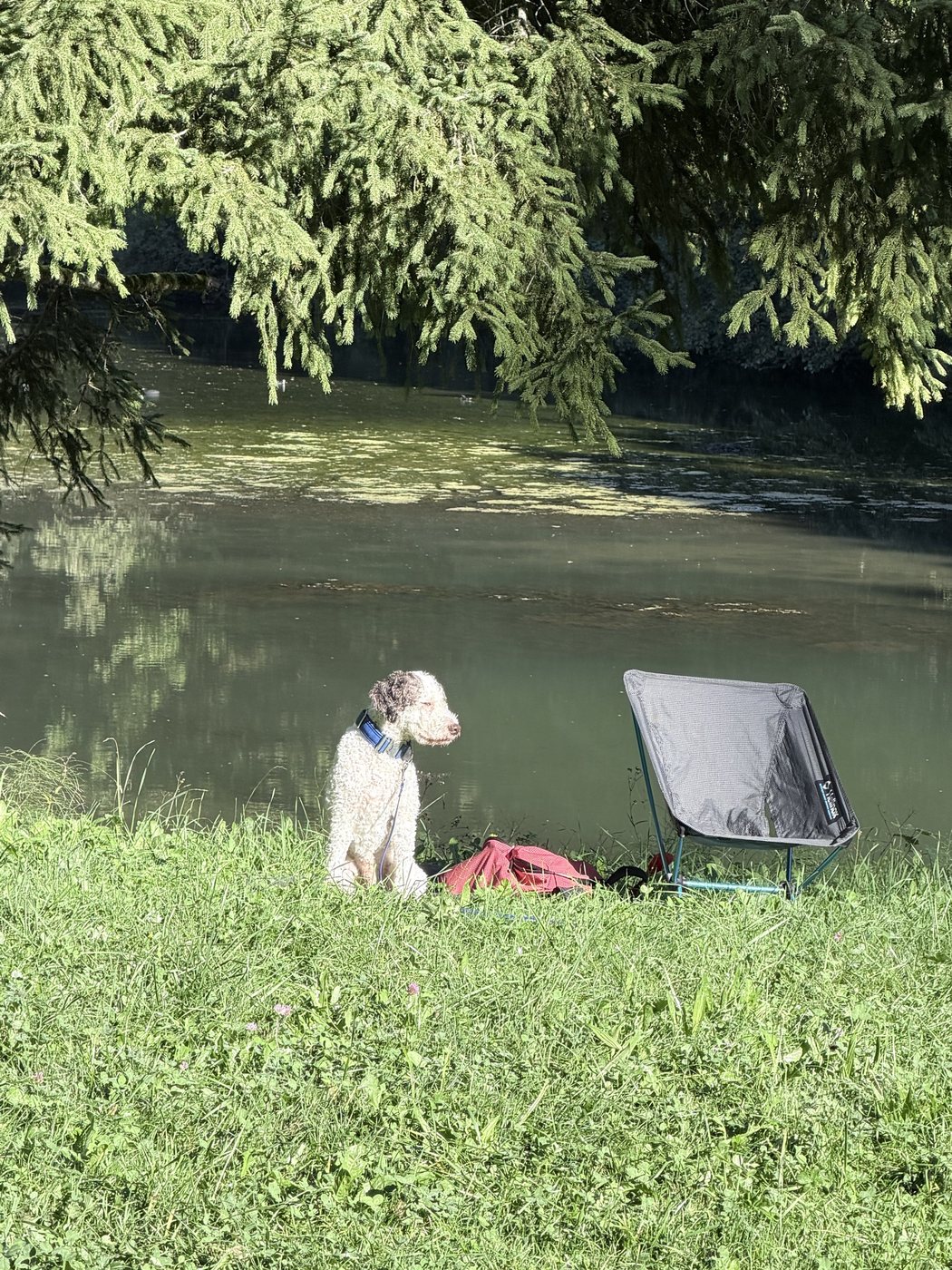
A Lagotto sits on the bank of a pond beside an empty folding chair, looking out over the water
A dog can sit and watch calmly on an unfamiliar shore if his person stays on top of things. That is switching off: settling in a place he doesn't know. It begins with calm at home.
Stefan Passet with his Lagotto in the dunes
Stefan PassetDog-training consultant, trained at the Natural Dogmanship coordination centre, qualified 2024. Training as an instructor with Jan Nijboer, qualifying November 2026. All sessions on Saturdays.
Book a Saturday
What's different here

Everyday routines that work, not commands.

Most dog schools work with commands and exercises, many with treats and a clicker. That teaches a dog exercises. I work on what comes before them: whether your dog feels safe, whether he knows who makes the decisions and whether he has a task that suits him. Once that is in place, you no longer need a command for calm, the lead or encounters. What is left is four signals. A command forces him against his impulse; a signal makes use of it.

Calm first, then tasks

Many owners think their dog needs more activity. Usually he first needs calm and clear routines at home. Everything else comes after that, and builds on it.

A task in place of treats

Your dog works for his own food, in a hunt modelled on the work his breed was developed for. That makes more sense to him than any reward from outside.

Lead, don't drill

Your dog follows you because you keep him safe and make the decisions, not because he has learned a word. That holds even when you aren't saying anything.

Lasting, not quick

Your dog can learn a command in two weeks. A dog who stays lying down in a café takes months, whatever the method. What he can do by then doesn't depend on a command, so it lasts.

Leadership

A dog follows whoever looks after him.

Your dog needs security, calm, a settled place in his group and a task that means something; for many breeds that task is a form of hunting. Living with people, he can hardly get these things for himself. So he looks for someone who will see to them for him, and he follows that person. If he finds no one, he takes charge himself: he deals with the door, the visitors, the dog coming the other way. The person he follows is the relationship giver; the dog is the relationship seeker. You take on the role his own parents would otherwise have played.

Relationship giver · the personRelationship seeker · the dog raises and leadslooks to him for that sets the examplecopies it has something to offerhas needs gives securityfeels secure

Whether you lead shows when something new turns up: a strange dog, a visitor at the door. Then you see who deals with it, you or your dog. If you handle it calmly and the same way every time, and your dog takes you at your word, you are leading. If he doesn't yet, pressure and punishment won't help. They create conflict and leave your dog frustrated or unsure of himself. You set clear boundaries elsewhere: for safety, and for what is yours, such as a place, food or an object. There you set them briefly and calmly, as a dog's parents do.

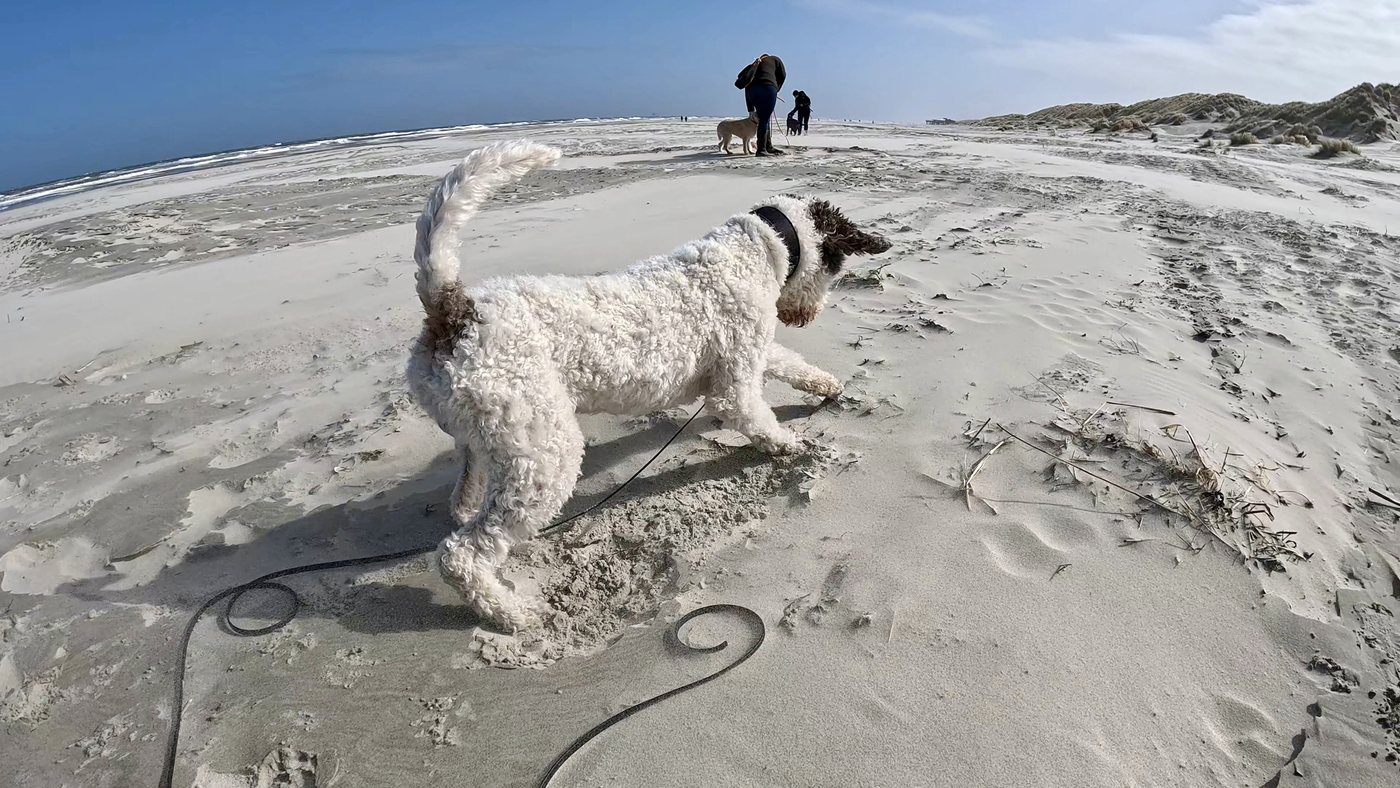
A Lagotto on a beach, the lead lying loose in the sand, other people with dogs far in the background
In an encounter you choose the distance and the direction. The lead stays loose, and your dog learns that encounters are your decision. You keep enough distance for him to watch instead of having to react.
Motivation

A task your dog needs.

Give your dog a task. It moves him from within when five things come together: he needs it, he can do it, he does it with someone he likes, it makes sense to him and it fires him up. That is motivation. Praise, treats or pressure work from outside. That is incentive. It usually works only for as long as you keep supplying it, and a dog easily comes to depend on it.

The substitute hunt (Ersatzjagd) is one such task. Every dog carries hunting behaviour in him, and each breed brings out one part of it: searching, pointing, chasing or retrieving. Much of what annoys you is exactly that: following a scent in the woods, running after bikes, driving the cat out of the garden. In daily life he is hardly ever allowed to act on it. So he gets a hunt tailored to him. The prey is a prey dummy, a cloth bag with his food in it that only you can open. It is his new bowl. After the hunt your dog eats from the dummy instead of from a dish, and his urge to hunt has a place with you.

With the prey he learns the four signals he needs. Fetch: he brings you the prey. Stop: he breaks off mid-run. Here: he comes, because the next part happens with you. Leave it: he leaves alone what is yours. He already knows leave it from home. It protects your body, your place and your things. And it protects him from roads and poisoned bait. None of these signals works against him: he stops because the prey ends up with you. We then practise all of this outdoors. In the woods the long line stays on until the stop is reliable.

And he learns to wait: until you send him, until he finds the prey, until the hunt is over. He needs that at the door, at the kerb and in encounters too. After the first session I tell you which substitute hunt suits your dog.

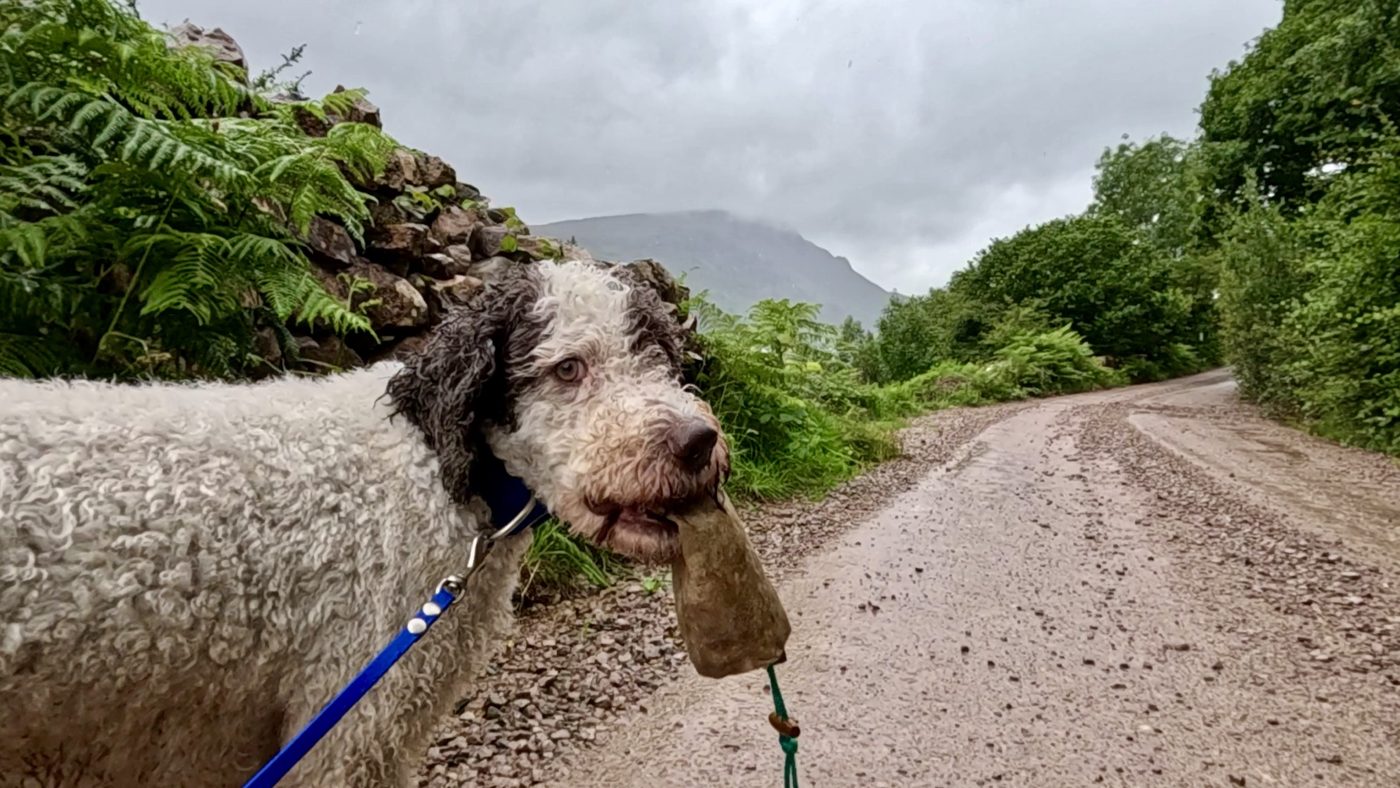
A wet Lagotto carries a prey dummy in his mouth, a mountain path in the rain behind him
The dog finds the dummy and carries it; only the person can open it. So the prey ends up with you, even in the rain on a mountain.
The path

Home first, then outdoors.

A dog behaves the way he feels inside: secure or insecure, calm or tense, in charge or not. I call this inner state his frame of mind. It forms in daily life, and your dog takes a good part of it from you. He notices the tension in your body, your pace and whether you stay calm when something new turns up. That is why I work with you, not only with your dog. When you move and make decisions differently, your dog comes to feel differently over time, and his behaviour changes with it.

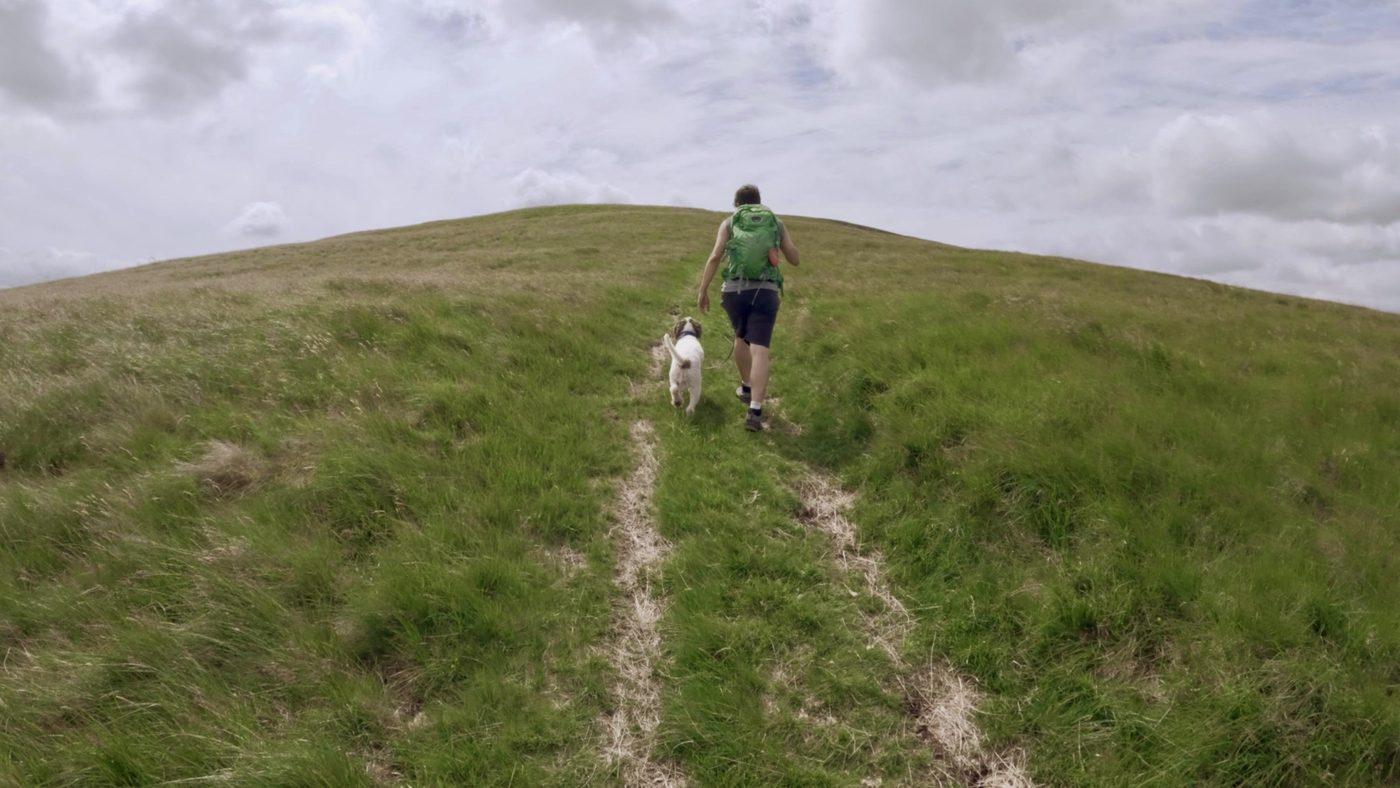
A man with a rucksack walks up a grassy slope, a young Lagotto following him on a loose lead
Whoever goes first chooses the direction and the pace. The lead hangs slack because the dog takes his bearings from the person, not from the lead.

The path runs through three environments. The first is the house: here your dog learns calm, finds his place and finds that you deal with the door, visitors and food. The second is the garden, or a quiet spot right by the house. The third is everything outside: the neighbourhood, fields, woods, town. We open it up one place at a time, and we start with the daily life of the two of you.

Every new place follows the same order. First your dog switches off there. Only then do we add a task, the substitute hunt for example, and only as many new things as he can take in. A place where he has switched off several times becomes familiar, and the next one is easier. That is how a dog who takes charge of a lot himself grows calmer, step by step.

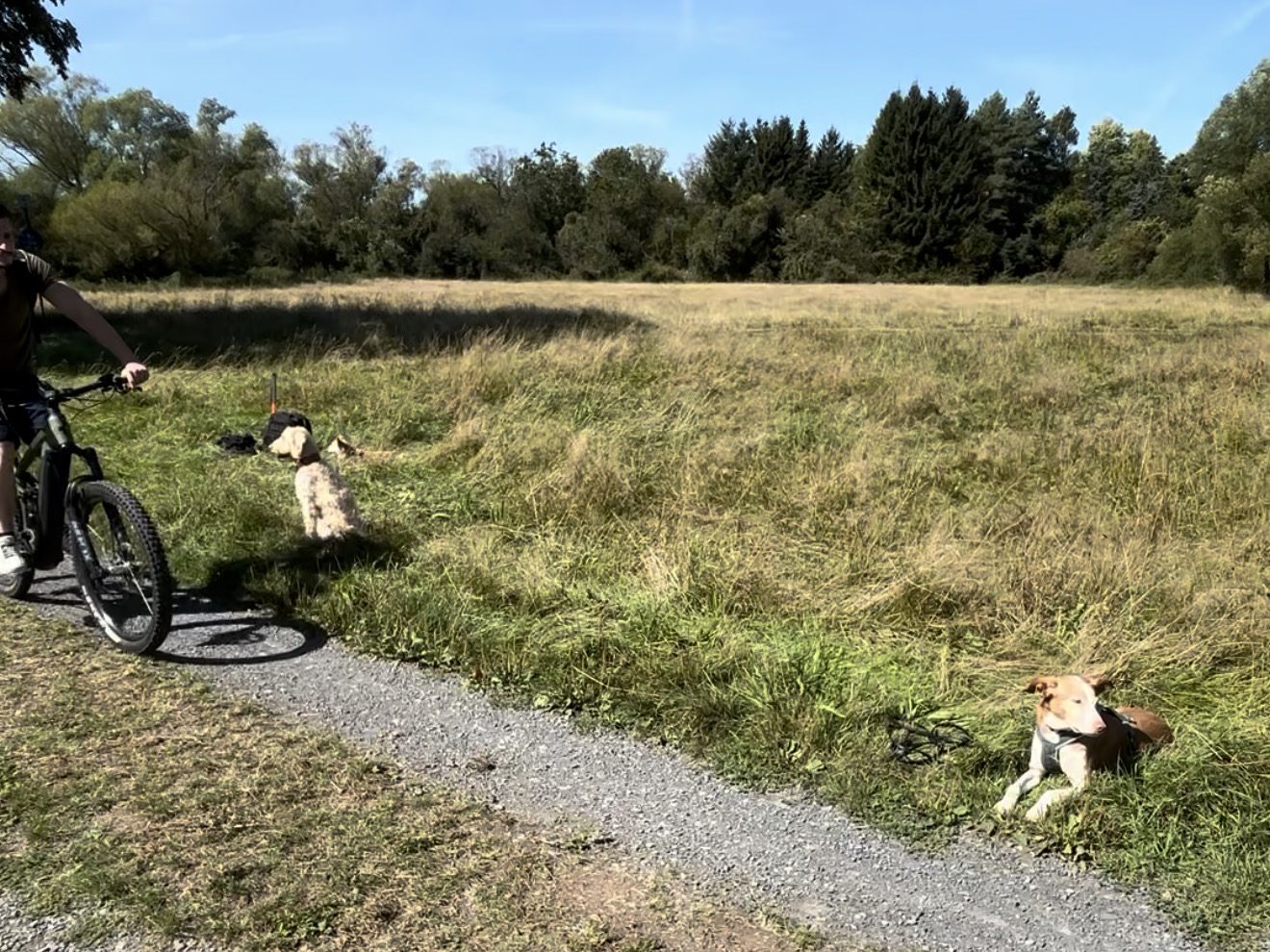
A cyclist rides past on a farm track, two dogs lying calmly in the grass beside it
A bike goes past; both dogs stay lying down. That is how it begins in every new place.
You are here Looking back Home calm setting Garden by the house New places one by one where hestands lay door · visitors · food build lead · first hunt prove switch off · task what haschanged
How I work

Five principles.

See the whole picture

I look at your daily life: who in the family does what, where the dog lies, how the day goes. A dog who barks at the door is usually reacting to something that happened earlier. That is where I start.

Take the breed seriously

I first ask what a dog was bred for. A retriever retrieves, a pointer points, a terrier would rather hunt alone, a herding dog steers with his eye, a cattle dog drives stock with pressure. From that I work out which task he needs and how much closeness.

See the individual dog

Every dog comes with a temperament, cautious or bold, lively or calm. That changes little. What grows is his confidence. How fast depends on his age, background and past experience.

Lead clearly, without force

I lead by example. I set boundaries as a calm adult dog does: with a look, the body, space, a low voice and, if need be, a brief nudge. I don't use training discs, spray collars or other gadgets. That is how your dog learns self-control: clear rules, plenty of warmth and freedom within the boundaries.

Keep a record

At the start I write down where your dog stands, from trust to how well he can wait. Later we look again at the same everyday situations.

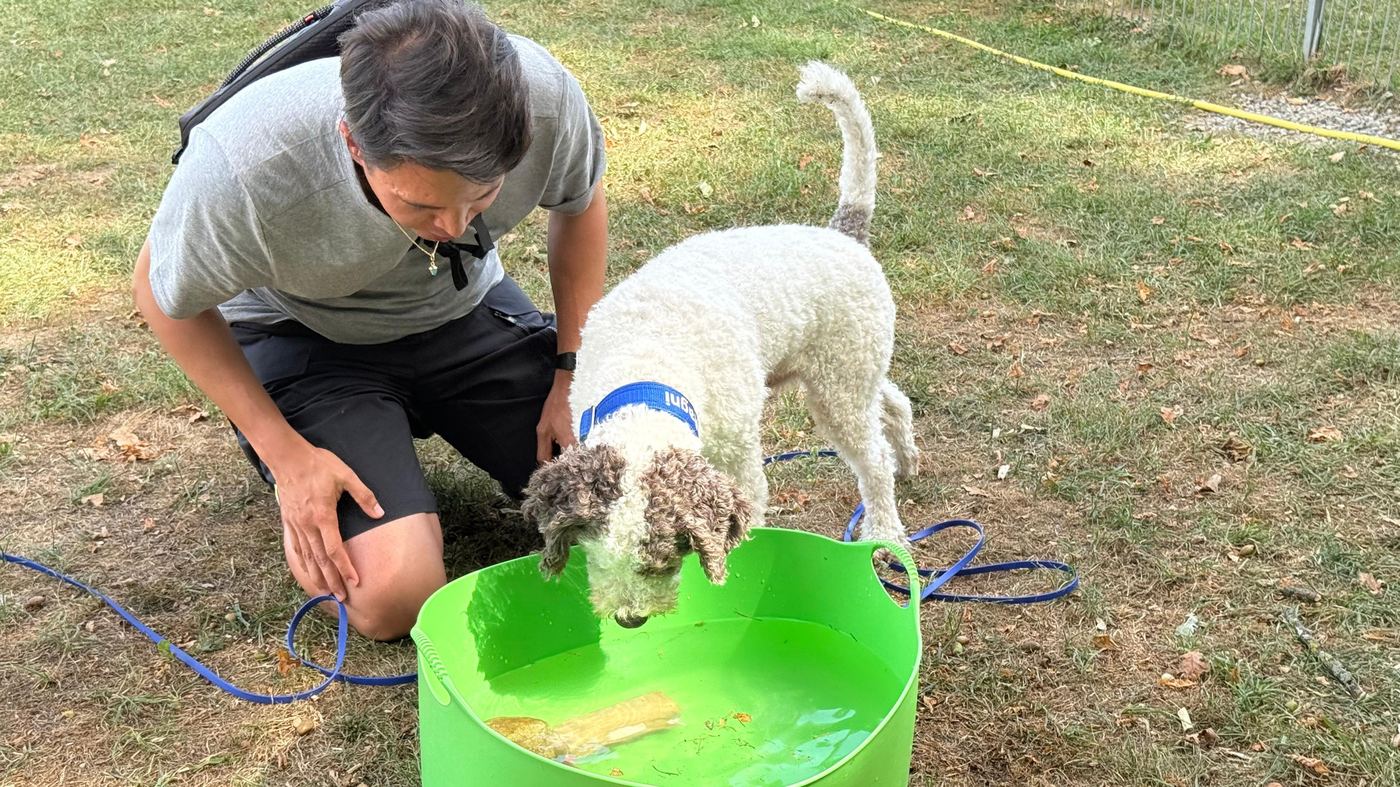
A Lagotto with his head under water in a tub, searching for an object
A dog's breeding history tells you which task he needs. A Lagotto is a water dog who searches and retrieves, so he gets his prey in the water. That is rarely enough for a herding dog; he needs a task he can solve only together with his person.
What I offer

What you can book.

Where you start depends on your dog's age. With a puppy we begin at your home, and then the two of you join the puppy group. With a dog of six months or more, we first meet outdoors for Erkundung (reconnaissance); after that you move to the group or to one-to-one training. The names come from the mountains: from Basislager (base camp) via Kehren (switchbacks) to Grat (ridge).

A team is you and your dog. Every group goes ahead, even if only two teams come. All sessions are on Saturdays. If you join by the end of June 2027, you pay today's monthly fee for twelve months, even if prices go up.

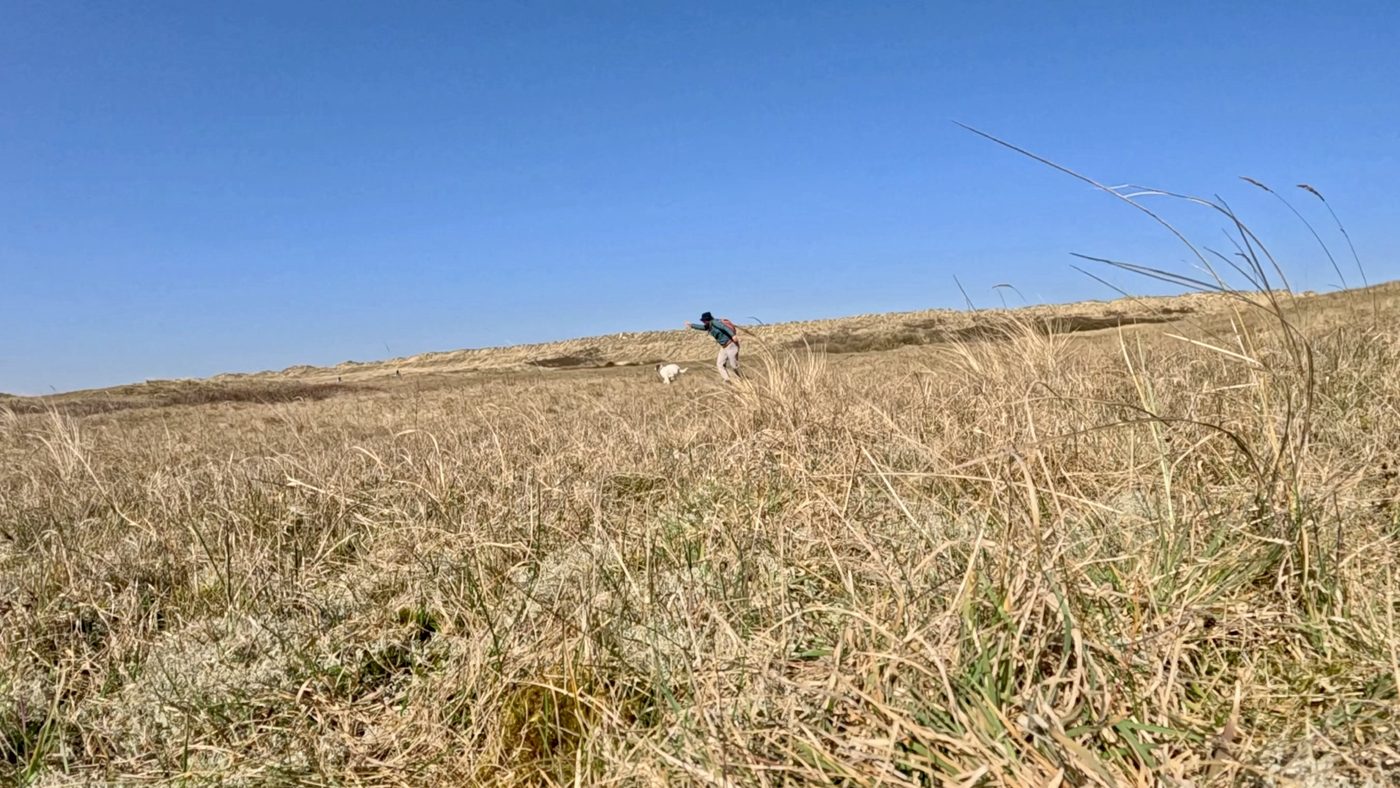
In the dunes a man sends his dog off with an outstretched arm, the dog running through the grass
The dog sets off only when he is sent. Waiting, searching and retrieving in a place he doesn't know: that is the work in unfamiliar places.
BasislagerPuppy course from arrival to six months: a two-hour home visit, then a 90-minute puppy group every two weeks, four puppies at mostCHF 140 a monthhome visit included, no travel costs within 20km · cancel monthly · Saturday 9am or 11.30am

Basislager, base camp, is where you settle in before the climb: sheltered, with everything within reach. It starts with two hours at your home, once your puppy has moved in. The whole family is there. Together we work out: where does his resting place go (not in the hallway, not by a door), and how does your puppy find calm there? Which rooms are off limits to him? How do the door, visitors and greetings work? How does he become house-trained, and where does he sleep the first few nights? How does he learn, in small steps, to be left alone? How does feeding from the prey dummy work? How do you set a boundary, and how do you hold the lead?

After that the two of you come to the puppy group every two weeks, once your vet gives the go-ahead. There your puppy learns to switch off in a new place. He plays under supervision with other puppies and calm adult dogs, then rests again. Search games with the dummy come in only once he feels safe in the place. You learn to read him and to step in before it gets too much. By the end you can set up a resting place, set a boundary briefly and calmly, and build a small substitute hunt. The monthly fee starts with the home visit. At six months you move on to Kehren.

ErkundungFirst session for dogs from six months: 90 minutes at a quiet meeting point, with a written assessmentCHF 180one-off · Saturday 1pm

Erkundung, reconnaissance, means looking over the ground before you set out. We meet somewhere quiet nearby, not at your home: I want to see how your dog responds to you when you're out and about. And you get to know me. With a few simple tasks we look together at who decides what between the two of you, how well your dog takes his bearings from you and which of your habits help him.

How it works. You send me your dog's name, breed, age and one sentence about him. I reply within two days with a date and a meeting point. We meet outdoors for 90 minutes. Within two days of that you get my assessment in writing, with a suggestion: group, one-to-one training or nothing. You pay by Twint or on invoice.

KehrenGroup for dogs from six months: two hours every two weeks at a few regular places, six teams at mostCHF 160 a monthtwo sessions of two hours each · cancel monthly · Saturday 9am or 11.30am · after Basislager or Erkundung

Kehren, switchbacks, are how you gain height: the same movement over and over, a little higher each time. Here your dog learns to accept boundaries, to wait and to take his bearings from you. He walks on a loose lead, rests beside other dogs and hunts with you. You learn to read him, to handle the lead and to judge how much he can cope with. One team works while the other dogs rest, in the car or at a distance; only dogs who can already cope with that may watch. We consolidate what your dog can do and extend it step by step. Adolescence can start as early as five months. While it lasts we add nothing new, because a lot is changeable at that stage. The five-metre lead stays on. New teams join when there is room.

HochlagerGroup day in unfamiliar places: one Saturday a month with dog encounters, five teams at mostCHF 200 a month10am to 3pm · cancel monthly · after three months of Kehren

Hochlager, high camp, is where you find out whether everything holds: unfamiliar ground, other rope teams on the same slope. One Saturday a month in a place the dogs don't know: a village, a station, a lakeshore, the edge of a wood. Each of these days takes one of two forms. One is calm among strange dogs. The dogs switch off for a long time. Where it suits, two dogs have brief contact, as casual and neutral as possible. We force nothing. An adult dog doesn't have to like every dog. A dog with good social skills doesn't play with all of them. He greets, steps aside, sets a boundary and accepts one. It is enough if he lets others go by calmly. The other form is the walk together: the group goes out as it would in daily life, on five-metre leads. After adolescence, and where the rules allow, we drop the lead step by step: first it trails on the ground, then it stays in the rucksack, once the stop is reliable. Once a quarter the day becomes a Grat, a theme day. The group chooses the theme: planned encounters with other dogs, a particular form of substitute hunt such as quartering, marking, the flirt pole or tracking, or an everyday outing with a train, a market and a restaurant. It is included in Hochlager.

SeilschaftOne-to-one training outdoors, when the group isn't right yet or you're stuck on something: 90 minutesCHF 180per session, with a written summary · Saturday 3pm or 4.45pm

In a Seilschaft, a rope team, one goes ahead and the others follow on the rope. You, your dog and me, at the meeting point. For dogs who still find the group too much, and for problems you can't get past. As many sessions as it takes, no package. Afterwards you get in writing what we saw and what to practise before next time.

What it costs in all, for example Puppy arriving at nine weeks: Basislager until six months, about four months, CHF 560, home visit included. Dog from six months: Erkundung CHF 180, then three months of Kehren CHF 480, CHF 660 in all. Keeping going after that: Kehren and Hochlager together CHF 320 instead of CHF 360 a month, cancel monthly. Good to know: For a second dog from the same household you pay half the fee in the group and nothing extra in a one-to-one session. Companions and children watch free. You can cancel one-to-one sessions free of charge up to 24 hours ahead.

If the price is what stops you, write to me. We'll look for a way together.

Book a Saturday
So you know beforehand

What you get, and what you don't.

You do most of the work between Saturdays, at home. It means changing your own daily routine, and that takes patience.

I work with you towards a dog who comes to you because the interesting things happen with you, and who likes walking beside you. If you want obedience on command, a smart drop on the word, you will find it done better elsewhere.

After a bite, or if your dog is very fearful, first have your vet check whether pain is behind it. If he needs veterinary behaviour therapy, I refer you on and, if you wish, work alongside it. I will tell you when something is beyond what I do.

If your dog has bitten or you are thinking of giving him up, put ‘Urgent’ in the subject line. I'll reply the same evening, weekdays included.

Questions about diet and health are for your vet.

Alprudel

Who's behind it.

On the alp, dogs have worked with people for centuries. They herd and drive on the herdsman's signals, for hours, off the lead, because the herdsman orders the day and the dog knows his place in it. Hence the name: Alp, the summer pasture, for this way of working together; Rudel, the pack, for the people and dogs who learn it here.

On a Hochlager Saturday it looks like this. Two dogs hunt with their people while three lie in the grass and watch. A walker comes past with a dog; none of them gets up. Later the group sets off, some dogs off the lead, others on a slack one, and at the station it waits until the train has gone. That is what it can look like when people lead. We work on it around the upper end of Lake Zurich: with families and their puppy, with owners of hunting and herding dogs, with dogs who bark and pull when they meet others.

I'm Stefan Passet, a dog-training consultant. I spent a year and a half training at the Natural Dogmanship coordination centre in Oberbölchen, with placements, a written assignment and an exam. I qualified in December 2024. There I learned to read a dog by his body language and signs of stress, to work out from his breed what he needs, and to see a puppy through imprinting and adolescence. Above all, I learned to advise people, because it is usually daily life at home that has to change first.

Since then I have been training as an instructor in Natural Dogmanship. In that training I am developing my own attitude to dogs. I am learning to put the approach across to owners so that it holds in daily life, and to change a dog's ingrained habits deliberately. I did my assistant days with Jan Nijboer, the founder of Natural Dogmanship, on a six-day intensive course on the island of Ameland. I qualify in November 2026. I practise what this page says with my own Lagotto. Alprudel is my Saturday work.
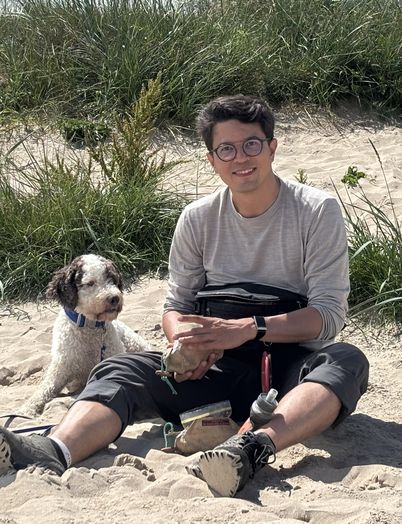
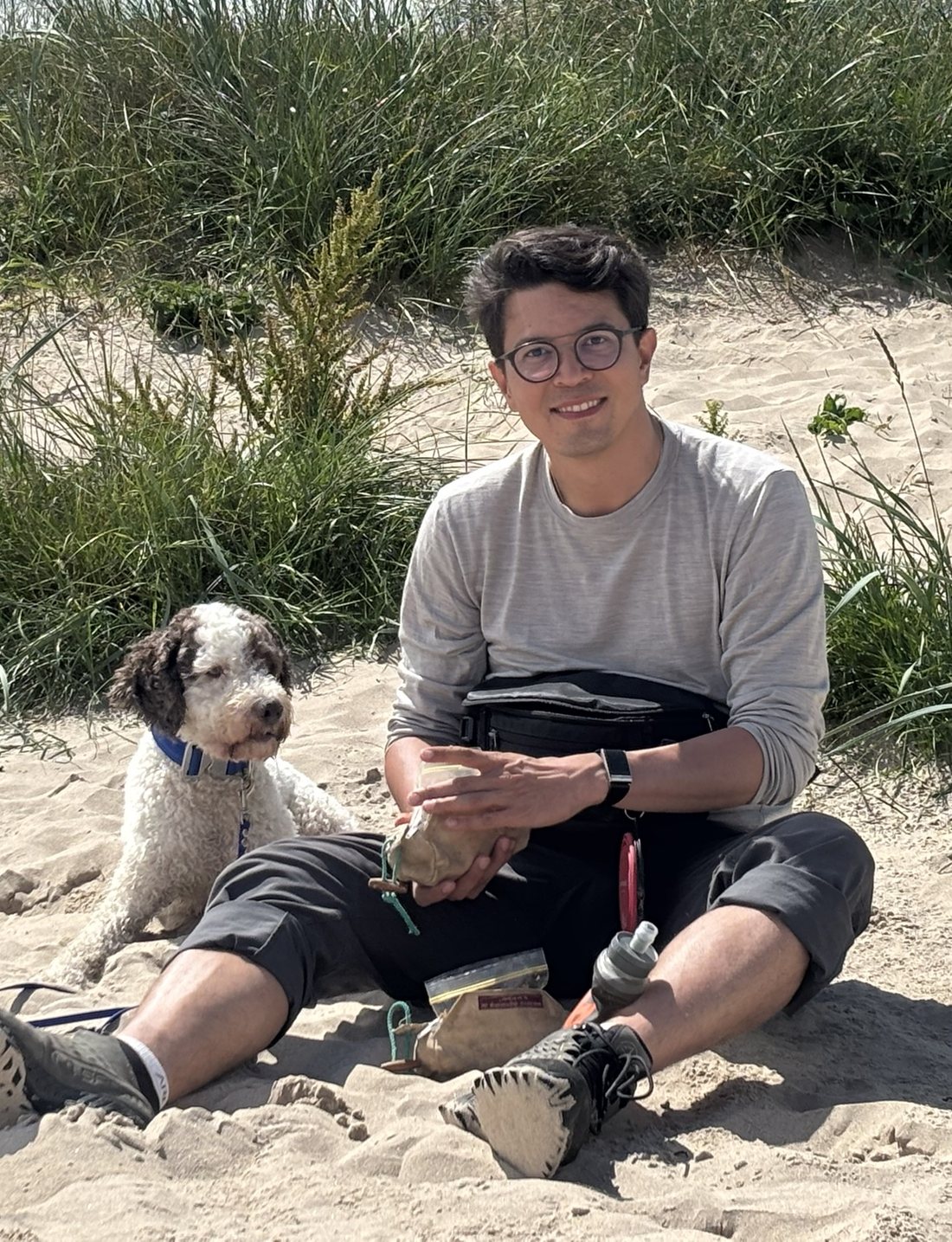
Stefan sits in a dune with the prey dummy in his hand, his Lagotto lying beside him
Questions

What owners ask me before they start.

Getting started
Do I need this at all?

If your dog walks along calmly in daily life, comes when called and can lie down near other dogs, probably not. If you notice that he deals with the door, the lead or encounters himself, it is worth a look. Come and watch first, without your dog and at no cost.

How long does it take?

At home you usually see a change in the first two weeks, at the resting place or the door, for example. Outdoors, allow two to three months. What your dog can do by then lasts, because it doesn't depend on a command.

Do I always have to carry a prey dummy?

At first, yes. The dummy is his new bowl: he eats his food after a task instead of from a dish. Outdoors you carry it until your dog knows it and expects something from you when you're out. Later you no longer need it for calm, the lead or encounters; for the substitute hunt it stays.

From what age?

From the day he moves in, and there is no upper limit. Puppies start in Basislager; dogs from six months start with Erkundung and then join Kehren. You move up to Hochlager when your dog rests in Kehren while another team works, and walks on a loose lead; that is usually the case after three months.

How do I sign up?

By email to hallo@alprudel.ch: your dog's name, breed and age, and one sentence on what's on your mind. I reply within two days.

Where do the sessions take place?

At quiet meeting points in Pfäffikon SZ, Freienbach, Wollerau, Altendorf and Lachen. You get the exact place with your confirmation. Every meeting point has parking, because the dogs rest in the car in between. Home visits within 20km of Pfäffikon carry no travel costs; beyond that it is CHF 1 a kilometre.

What do I need to bring?

Food in the prey dummy (one meal for a puppy, part of the daily ration for an adult dog), a five-metre lead, up-to-date vaccinations and dog liability insurance. Toys and treats stay at home, because your dog works for his food. Your dog eats nothing before the session. If you don't have a dummy, I'll bring one. Also water, a blanket for the car and shoes that can get wet.

I don't have a dog yet. Is it worth talking?

Yes. We go for a 90-minute walk, without a dog, and talk about your daily life: work, home, family, sport. Afterwards I tell you which breeds suit it and which don't, and what to sort out at home before a dog moves in. CHF 180, with a written summary.

My dog is a rescue. Will this suit him?

Yes. First give him two or three weeks of calm and fixed routines at home before we meet outdoors for Erkundung. After that, his background and past experience set the pace. I email you beforehand with what to watch for during that time.

Can children come?

Yes, to watch. In the group an adult handles the dog. At the home visit the whole family is there, because the dog reads everyone.

With a puppy
Can I take my puppy for walks?

I advise against it. Your puppy should get to know plenty of new things, but one place at a time and in small helpings, or it all becomes too much for him. You carry him to different spots; there he does a small substitute hunt he is sure to succeed at, and then settles in that place. In Basislager I show you how this works, and when the lead and short outings from your front door come in.

How do I house-train him?

Carry him out at least every two hours, and straight after eating, sleeping and playing, to the same spot each time. Praise him calmly, and don't punish him.

Where does he sleep the first night?

Ideally in the same room as the person he is closest to. A bed in the hallway can tell a puppy that guarding the house is his job and that he is on his own.

He bites my hands. What should I do?

As soon as he bites your hands or takes no notice of your body, step out of the puppy's pen calmly and without a word. The pen is a fenced-off area, behind a puppy gate for example. His resting place is inside it, and so is a spot where you often spend time, so that the two of you meet there. There is no play at the resting place. Because you are there often, he gets plenty of chances to learn from the mistake.

How much activity does he need?

One small task per active phase. A puppy has several of these a day besides his sleeps; you split his food across them, and each one ends with the task and a meal. Over time the phases become fewer, until your dog has only one meal and one active phase a day.

Children and a puppy?

Only under supervision. The resting place is off limits to children, and they play search and fetch games instead of tug.

In daily life
My dog pulls on the lead.

There are several possible reasons: he thinks safety is his job and has to be in front; the surroundings excite him so much that he can't control himself; or he wants to keep the group together. In Erkundung we look at what lies behind it for your dog. We then practise the loose lead itself where there is little going on, and only after that in the neighbourhood.

My dog barks or kicks off when he meets other dogs.

Often your dog deals with the encounter himself because nobody else does; sometimes he is reacting to bad experiences with strange dogs. After Erkundung I tell you whether he can already watch in the group or whether we work one-to-one first, either way at a good distance. Many dogs change after two to three months; I don't promise a deadline.

How can I tell my dog is tense?

He pants when it isn't hot, stares fixedly, leans into the end of the lead before the other dog is there, or takes a long time to lie down again. Then he is tense before the encounter has begun. That is where we start: you keep your distance, stay calm and deal with the situation.

My dog snaps at hands or guards his food.

First have your vet rule out pain. Then we meet for Erkundung and work one-to-one in Seilschaft; you join the group once that is working. Until then, avoid the conflict: leave nothing lying around that he might guard, and his food goes into the prey dummy instead of the bowl.

My dog hunts.

The urge to hunt stays. He gets a substitute hunt tailored to him, and we practise the stop on it. Until the stop is reliable, the long line stays on in the woods.

Will my dog learn a recall?

Yes, as ‘here’. Your dog comes because his next task is waiting with you. Stopping mid-run is a separate signal, the stop. We build both on the substitute hunt.

My dog is unsure of himself.

Then we start one-to-one, in Seilschaft, and go more slowly. He doesn't have to like everything. It is enough if he finds that you deal with such situations.

Practicalities
Bitch in season?

She doesn't come to the groups while she is in season, about three weeks. She is welcome at Erkundung and the home visit. The monthly fee is paused during that time.

And if it rains?

We work outdoors, rain included. If there is a thunderstorm or a gale, I cancel the evening before and we make up the session.

Cancelling and giving notice?

You can cancel one-to-one sessions free of charge up to 24 hours ahead. You give notice on monthly fees by email, to the end of the month. Everything else is in the terms of participation.

Does this count as the compulsory Zurich course?

No. I don't offer the canton of Zurich's compulsory dog course.

Contact

One sentence about your dog is enough.

Your dog's name, breed and age. One sentence on what's on your mind. I reply within two days and give you the next Saturday.

Emailhallo@alprudel.ch

Write an email

Meeting points in Pfäffikon SZ, Freienbach, Wollerau, Altendorf and Lachen, depending on the group and the dog. Home visits within 20km of Pfäffikon carry no travel costs: Wollerau, Bäch, Richterswil, Wädenswil, Rapperswil-Jona. Beyond that, CHF 1 a kilometre. During the week you can reach me by email. In an emergency, contact your vet.